“Size it right. Run it better. Pay it back fast.”
THERMEL INGENIERIE: optimising district heating networks through digital simulation, for engineering firms, network operators and local authorities.
Introduction
Digital simulation plays a role at every stage of a district heating network’s life: its construction, its expansion, and its operation.
For a new network, it makes sizing reliable right from the design stage: diameters, flow rates, pressure, heat exchangers… and helps optimise every choice, with a direct impact on both construction and operating costs.
An existing network, meanwhile, never stays static: an added loop, a new customer connected, an extra boiler, a replaced pump. Each of these changes, even a minor one, shifts the hydraulic and thermal balance of the whole network and gradually erodes a clear understanding of how it actually behaves. Digital simulation is the way to fix that.
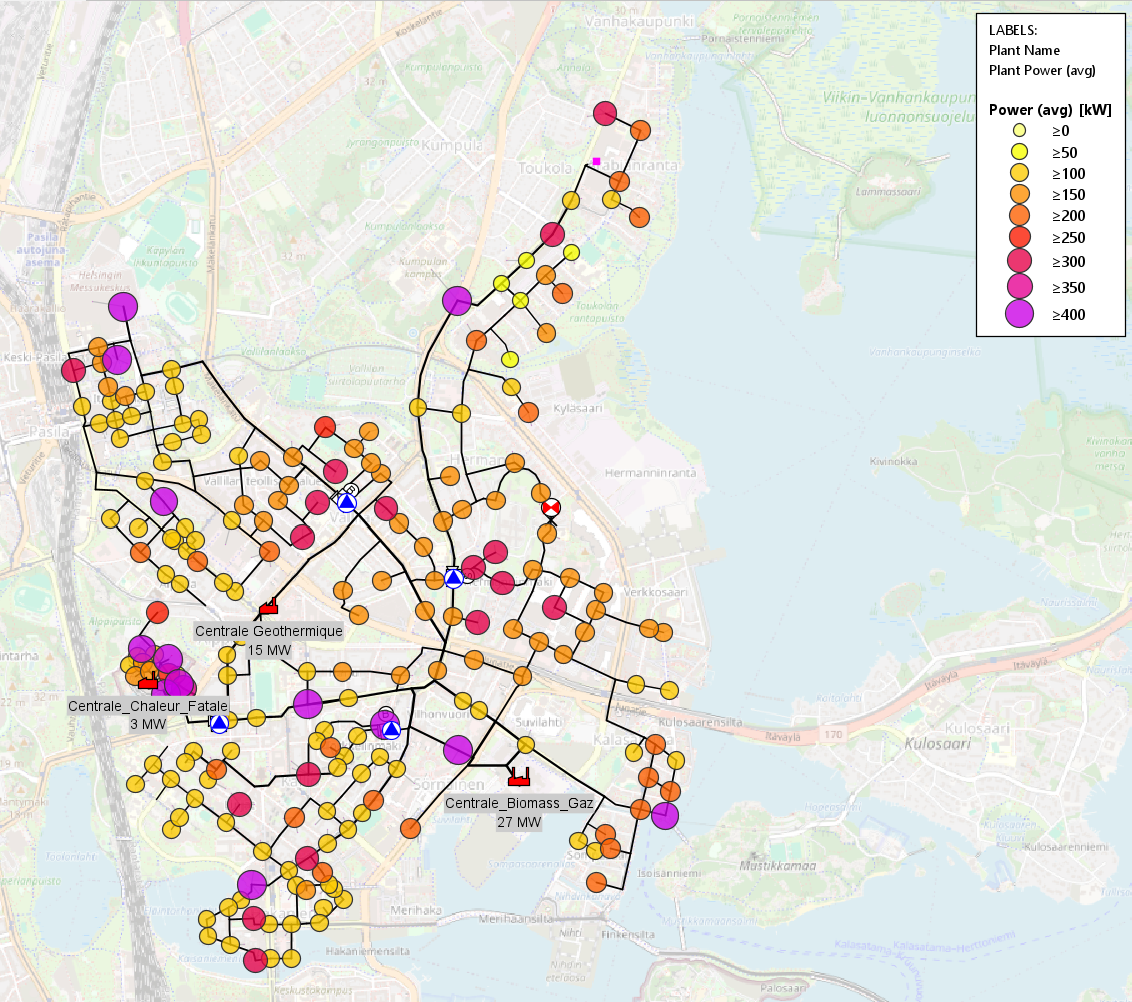
On an operating network, especially one that is multi-source and meshed, it is simply not possible to understand what is happening at every point without simulation. Digital simulation reconstructs the full behaviour of the network, in all its complexity. This makes it possible to anticipate drift, test a change before committing to it, and support day-to-day operation — optimising operating costs, boiler sequencing, merit order, and renewable energy share along the way.
Why choose digital simulation?
Digital simulation lets you test, validate and optimise a district heating network before starting work or modifying an existing one. Here’s what it delivers in practice:
✳
Less oversizing
Correctly sized equipment — neither over- nor under-sized — to avoid unnecessary investment costs.
✳
A fast return on investment
Every euro spent on simulation can save several more on construction and operation of the network.
✳
Secured decisions before construction
Validate technical and financial assumptions before work begins, to reduce risk.
✳
Higher-performing operation
Fewer thermal and hydraulic losses, for a more efficient network throughout its lifetime.
Who is this for?
✳
Engineering firms
Ad hoc technical support for your sizing, extension or district heating feasibility studies.
✳
Network operators
Diagnostics of your existing network, hydraulic optimisation and day-to-day decision support.
✳
Local authorities & project owners
An independent, plain-spoken perspective to secure your technical choices and investments.
My method
A four-step working method, in partnership with your team
✳
1. Data
Collecting the network map (GIS / shapefile) and existing data: consumption, load curves, characteristics of the equipment in place. This foundation determines how reliable the rest of the work will be.
✳
2. Scoping
Technical discussion with your team to pin down the project’s challenges and constraints: planned extension, performance goals, technical or financial constraints. This is also where we define, together, which scenarios to study.
✳
3. First results
Building the model and simulating the network. I flag the limits identified — hydraulic, thermal, at the plant or at the pumps — and the margin for manoeuvre available in each scenario.
✳
4. Final results
A follow-up discussion on the results to adjust assumptions if needed, followed by delivery of the technical conclusions tailored to your needs: final sizing, operational support, identification of spare capacity, or any other answer to the challenges defined earlier.
A technical partner: Fluidit
Work carried out with Fluidit
For these studies, I draw on the technical support of experienced engineers who have worked on generation 2 to 5 district heating networks across Europe.
I also rely on Fluidit Heat, the simulation software developed by Fluidit, a Finnish company specialising in the modelling of urban district heating and cooling networks. The tool performs detailed thermo-hydraulic simulations — in real time as well as over long periods — for sizing installations (production units, pumps, pipes) and for operational support (supply temperature optimisation, scenario testing, backup plans).
This partnership lets me draw on skills and a robust tool, proven on large-scale networks, to run reliable studies regardless of the size of your network.